


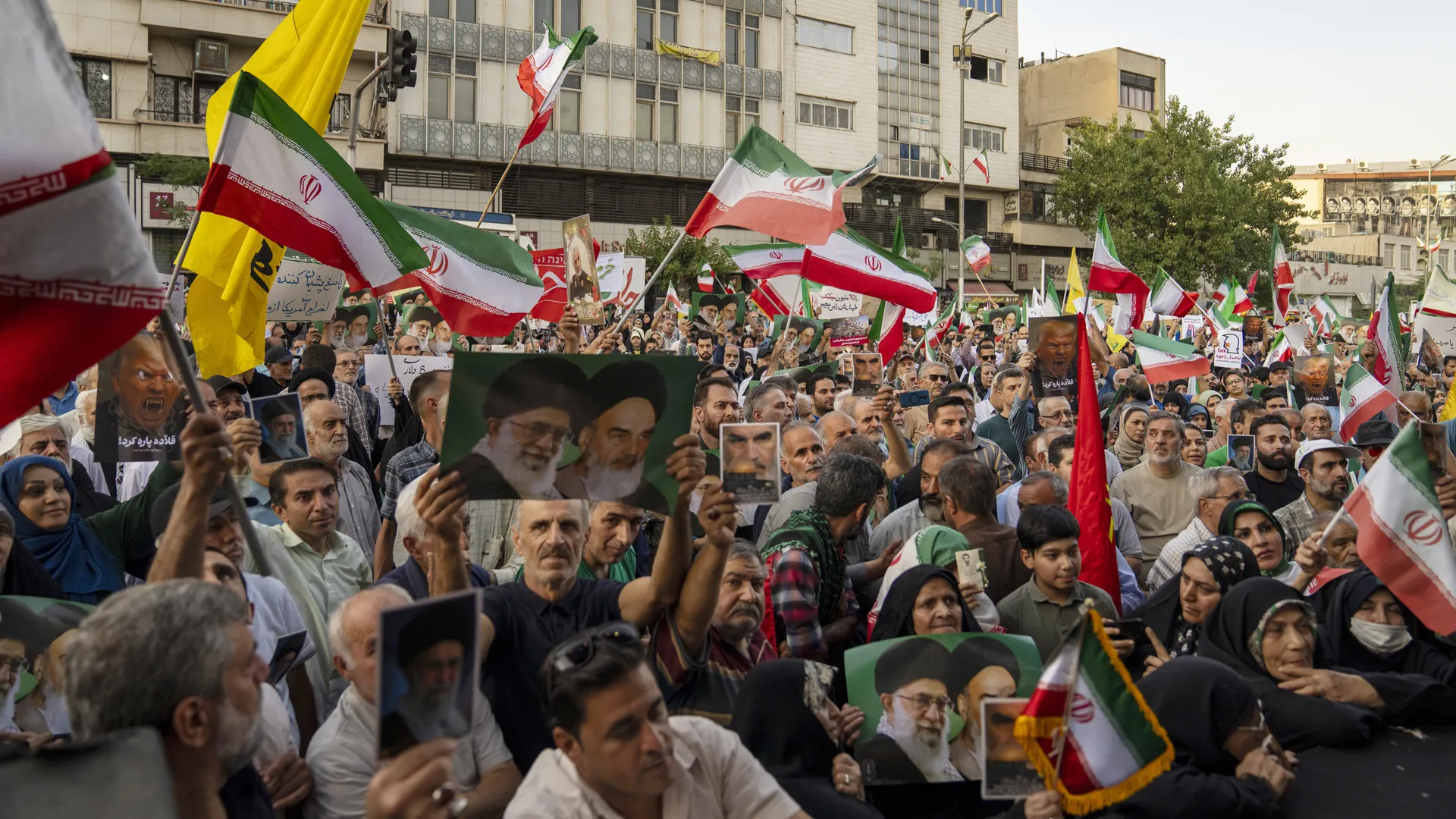
The most recent wave of protests in Iran began not with students or ideological dissidents, but with a deeply frustrated merchant class reacting to the country’s deteriorating economic conditions. What started as economic grievances quickly metastasized into nationwide demonstrations against the theocratic regime itself.
Unrest is nothing new in Iran. The Aban fuel protests of 2019, were savagely repressed and led to the death of 500 civilians. In 2022, the death of Mahsa Amini while in police custody sparked the "Woman, Life, Freedom" demonstrations, with a similar number of demonstrators being killed and tens of thousands of individuals ending up in custody. However, the scope and magnitude of this most recent demonstration seem to be different. According to estimates, well over four million people (the true number is certainly much higher) nationwide took part in the protests which lasted just under a month, which is a remarkable number in a state known for its widespread repression and surveillance.
The government’s response was tragically predictable. Security forces moved swiftly and forcefully. Mass detentions, widespread massacres, and executions of individuals accused of little more than participating in protests, eventuated with unprecedented scale. An internet blackout was imposed by the government, obscuring the full scale of the crackdown from the outside world and limiting Iranians’ ability to communicate internally.
All of this unfolds within a political system that appears increasingly strained in its efforts to maintain both authority and legitimacy at home and abroad. Economic stagnation, demographic divides, and ideological differences of the youth when compared to the Old Guard, have eroded much of the revolutionary feeling that once underpinned the regime’s claim to outright authority.
Yet almost as quickly as images of protest surfaced, external rhetoric shifted the frame. Calls from Donald Trump urging Iranians to sustain revolutionary momentum were amplified across social media. The conversation in parts of the West moved rapidly from humanitarian solidarity to overt discussions of regime change. Leaders in the United States, Israel, and elsewhere began to speak less about supporting civil society and more about destabilizing the ruling establishment of the Ayatollahs.
What began as an expression of empathy for Iranians confronting repression at home, turned quickly into global geopolitical ambitions of major nation states, with the aim of ending the Ayatollah's rule, or even further, the destruction of the Iranian state itself. But is this latter objective wise? Should Western nations’s policy towards Iran be bent on military action with the sole goal of regime change?
Two things can be true at once
You would be hard-pressed to find anyone in the West who disagrees with the moral case against the Iranian regime. It has systematically persecuted political opponents, dismantled what was once a largely secular society in favour of theocratic authoritarianism, and sponsored militant proxy groups across the Middle East. Having friends and acquaintances who have been directly affected by this repression with their families fractured, their lives uprooted, and exile forced upon them, causes me to have deep hostility toward the regime. Witnessing the sheer number of protestors and advocates in Australia that took to the streets to demonstrate their disgust at the recent regime’s political persecution, cemented in my mind the likeminded attitude of a majority of Australians. Anyone who undertakes even basic research into post-revolutionary Iran, is likely to arrive at a similar emotional conclusion.
However, emotional clarity alone is not a sufficient basis for foreign policy decisions. It is incumbent upon political leaders and citizens to rise above immediate emotional reactions and apply critical, pragmatic reasoning. Would regime change in Iran actually work, and would it improve the lives of ordinary Iranians? Would it serve American strategic interests or advance long-term regional stability? On both counts, the evidence strongly suggests the answer is no.
It would be both a strategic and moral failure to try to uproot the government in Iran through military means. There are many structural barriers that make it near impossible for a transition to succeed. The power of the Iranian Revolutionary Guard Corps, the Iranian grip on the straights of Hormuz, and the lack of a credible and legitimate post-regime leadership alternative, all point to a military option when engaging with Iran, that will likely result in long-term global instability, suffering for Iranian civilians, and further foreign distraction for the United States. Both American foreign policy and, more importantly, the Iranian people, would be worse off than they were before. In the words of journalist and Zeteo founder Mehdi Hasan, regarding the problematic situation in Iran we have to be able to “walk and chew gum at the same time”.The structural barriers to regime change
It is critical to remember that the explicit purpose of the Islamic Revolutionary Guard Corps was to coup-proof the clerical regime. The 1979 revolution offered a formative lesson to Iran’s new rulers. When the secular military declared neutrality, the Shah’s government collapsed. Similar military interventions and coups in Turkey reinforced this lesson. For the clerics, the conclusion was clear. Regime survival required a parallel force loyal not to the nation, like the Iranian military is sworn to protect, but to the regime itself.This reality destroys the romantic narrative of a popular, bottom-up revolution toppling the theocratic authoritarian leadership. It is just that. A narrative. History suggests that revolutions succeed only when the military either leads the process or stands idly by. Mass mobilization alone is rarely a sufficient condition for a successful overthrow of an established regime . The IRGC exists precisely to prevent such a thing from occurring, acting as a strong structural barrier to revolutionary change.
This fact is often unsurprisingly absent from the rhetoric of regime-change advocates. It is not a matter of bribing senior commanders or assuming that public unrest will inevitably force the military to side with the population. The IRGC’s institutional power and ideological commitment to the clerical regime has just been shown through their brutality in dealing with the current protests.
Beyond internal dynamics, there are serious geoeconomic consequences to consider, most notably the near-certain Iranian response of threatening to close the Straits of Hormuz. This vulnerability has long constrained U.S. policy. During the brief Israel–Iran confrontation often referred to as the “12-day War” in June last year, the Trump administration was acutely aware that pushing Iran toward a perception of existential threat could trigger a disruption of the world’s most critical oil chokepoint. Oil prices matter. And when Trump is facing a cost of living crisis on the home front, I doubt he needs further disruption to the global oil and petroleum market.
Finally, and perhaps most damaging to the regime-change case, is the question of post regime leadership legitimacy. The individual most frequently promoted in Western and Israeli discourse as a potential interim leader Reza Pahlavi, son of the deposed Shah, suffers from a profound legitimacy deficit. Even setting aside widespread Iranian hatred toward restoring a Pahlavi after more than four decades, his overt alignment with U.S. and Israeli interests would brand him immediately a foreign-backed proxy. While he might poll more favourably than the current clerical elite, legitimacy in Iran cannot be manufactured externally.
An Iranian leader perceived as subordinating national sovereignty to Washington or Tel Aviv would face immediate public resistance. The tragedy for the Iranian people is that any viable domestic opposition has been systematically purged, making the emergence of an indigenous, and legitimate alternative, increasingly unlikely.The deeper geopolitical game
Let us begin with Israel. While Israeli officials frequently invoke concern for the Iranian people, it is difficult to ignore the deeper strategic logic behind their emotion-clad rhetoric. Israel, obviously, benefits directly from a weakened, destabilised Iran. From this perspective, the success or failure of a coherent post-regime outcome is largely irrelevant. Dysfunction itself is the objective from an Israeli perspective. This helps explain why apparent contradictions in regime-change advocacy are treated as secondary concerns by Israel. A fragmented Iranian state would advance Israel’s regional position in much the same way that a devastated Iraq and Syria did. As retired Colonel Douglas MacGregor has observed, “the Israeli view is, if the region is in turmoil, then we are safe.” Within that framework, instability is not a risk. From the Israeli perspective, it is actually desired. It is no wonder why Pahlavi has such backing from the Israeli government.It is also unsurprising that Israel’s intelligence services have been so unusually overt in their messaging. Mossad’s recent public statements on X, urging Iranians to take to the streets and claiming active involvement “on the ground” show how internal unrest is viewed not as a humanitarian crisis but as a strategic opportunity for Israel. The Iranian protest movement became an opportunity for leverage and a useful propaganda tool for the Israeli government.
However, what serves Israel’s national security interests does not automatically serve those of the United States, the broader West, or the Iranian people. These interests are clearly not identical. Iran poses little direct security threat to the U.S. or to Western Europe. It is also worth recalling that there is only one nuclear-armed state in the Middle East. Israel. Not Iran.
Despite campaigning against endless wars and a liberal-interventionist foreign policy, the Trump administration appears no less subservient to Israeli strategic priorities than its predecessors, and arguably more so. This was evident during internal deliberations on potential military action against Iran in January, when Trump reportedly hesitated only after advisors warned that the U.S. lacked adequate defensive capabilities to protect Israel and American personnel in the region.
Trump has pursued an even more hardcore Iran policy than in his first administration. He scrapped the JCPOA in 2017, only now, to be seeking a far more significant agreement. This is reported to include the complete dismantling of Iran’s civilian nuclear program, severe restrictions on its ballistic missile capacity, and an end to its regional proxy relationships. No Iranian leadership, secular or clerical, could plausibly accept such terms, particularly after having been militarily targeted by the same actors across the negotiating table mid last year. In fact the very opposite is true. The only lesson that an Iranian leadership could take from recent history, is that it pays to have a deterrent. Especially a nuclear one. Sadam’s Iraq and Gaddafi’s Libya, even modern day Ukraine, stand as poignant reminders of the futility of conventional defence when faced by an overwhelmingly powerful aggressor. The largest buildup of US military force in the Middle East since 2003, along with escalating rhetoric about pursuing the “hard way” has politically boxed the administration into an increasingly narrow set of options. As Colonel Douglas MacGregor states, “if you are in the position of President Trump given the rhetoric and given your public statements and posturing… it becomes almost impossible to retreat from these policy positions.” Finally, there is the battle over the broader narrative of military action against Iran. After the bombing of the Fordow nuclear enrichment facility last year, both Trump and Netanyahu claimed that Iran’s nuclear deterrent had been effectively neutralised. That statement severely weakens the credibility of future military action justified on nuclear grounds. The rationale for confrontation has continually shifted. First preventing nuclear weaponisation, then eliminating civilian enrichment, then curbing regional alliances, and now openly advocating for all out regime change. The goal posts continually move when it comes to the propaganda war. For a president who campaigned on limiting foreign entanglements, it is difficult to see how such escalation will lift President Trump’s public support. Increasingly, the American public recognises that these conflicts, whether it be Ukraine, Venezuela, or Iran, distract from what many view as the defining strategic contest of the century. China. The long-articulated “pivot to Asia” strategy, endorsed by three successive US administrations, is fundamentally undermined by renewed military adventurism in the Middle East. Make no mistake. Military action on Iran, and the risks of real escalation, do not serve American grand strategic interests. More money and weaponry pinned down in the Middle East is money and weaponry that CANNOT be used to balance out the Chinese threat.